



Four shrimp producers, four different paths to growth
Ecuador continues to break production records while India proves resilient, Vietnam builds on processing and domestic demand, and Indonesia seeks a route back to growth after a dificult period for farmers.
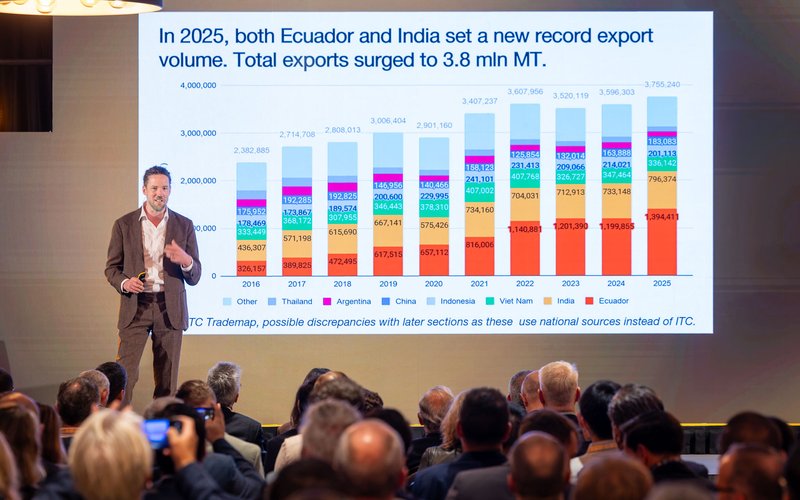
Credits: Global Shrimp Forum
Global shrimp trade continues to expand, but the world's major producing countries are following increasingly different paths. Ecuador is setting new export records, India has proved more resilient to trade disruption than expected, Vietnam combines domestic production with a substantial processing industry, while Indonesia is trying to restore production after declining profitability and an unexpected market-access shock.
Presenting the latest trade statistics at the Global Shrimp Forum, Willem van der Pijl showed that global shrimp exports surged to 3.8 million tonnes in 2025, with both Ecuador and India setting new export volume records. At the same time, developments in Vietnam and Indonesia demonstrate why export statistics alone increasingly provide only part of the picture.
Ecuador: Growth shows little sign of stopping
After export growth paused in 2024 at around 1.2 million tonnes, Ecuador returned strongly in 2025, reaching approximately 1.39 million tonnes. The expansion continued during the first half of 2026, when exports reached approximately 822,000 tonnes, 14% above the previous year. If El Niño conditions do not significantly disrupt production during the second half, exports could approach 1.6 million tonnes for the year.
China remains Ecuador's largest market, taking around half of exports in the first half of 2026, but other destinations are becoming increasingly important. The US has overtaken the EU as Ecuador's second-largest market, while shipments to other Asian destinations have also expanded, including volumes destined for further processing.
That diversification is increasingly extending from markets to product formats. Marcelo Vélez, chairman of the Board of Ecuador's National Chamber of Aquaculture (CNA) and president of the Board of Edpacif, said recent tariff issues and changes in Chinese inspections for metabisulfite have encouraged greater flexibility
“We are trying to change from China to other markets, but also we are switching the products that we are producing,” Vélez said. He explained that some peeling is also being undertaken through collaboration with processors in countries such as Malaysia and Indonesia, a trend he expects to continue.
Vertical integration is another feature of Ecuador's evolution, with large farmers increasingly becoming exporters themselves. The country's export sector nevertheless remains relatively concentrated: the five largest exporters (Santa Priscila, Songa, Omarsa, Expalsa and Exportquilsa) accounted for around three-quarters of shipments in 2025.
India: Resilience under trade pressure
India provides a different story. Farmed shrimp exports increased 9% from 733,148 tonnes in 2024 to 796,374 tonnes in 2025. Despite expectations that US tariffs would result in a substantial contraction, overall export volumes remained comparatively resilient as exporters redirected product toward other markets.
China, the EU and Vietnam took more Indian shrimp in 2025, while China, Japan and Russia absorbed much of the volume lost in the US in 2026.
But India's response is about more than changing destinations. Sarabpreet Singh Matta, General Manager at Devi Seafoods, argued that assessing India solely by production volumes overlooks changes in processing. “We should not benchmark India just based on production. We also have to look at the resilience and competence of the Indian processing sector: how it has taken the product into new markets, strengthened existing markets, diversified and improved compliance,” Matta said.
He also pointed to increasing investment in value addition, which could allow India to expand value even without very large increases in physical volumes.
Species diversification provides another potential route to greater resilience. Black tiger shrimp exports increased substantially in 2025, although expectations for 2026 are reduced following flooding in Gujarat and significant disease pressure. Vannamei nevertheless remains India's dominant species.
Alluri Indra Kumar, Chairman and Managing Director of Avanti Feeds, said the feed industry is prepared to support a broader species mix. “The industry is geared up for the different species. We started with black tiger, then came vannamei, and indicus was there in the early stages. As a feed industry, we are prepared for species diversification and for the nutritional requirements of the different species.”
At farm level, however, prices and disease remain decisive. Van der Pijl noted that farm-gate prices are farmer year-on-year in Indian rupees, although the depreciation of the rupee makes them appear weaker when converted into US dollars. More recently, prices have strengthened further, providing farmers with an incentive to stock for the second crop.
Ravi Kumar Yellanki, CEO of Vaisakhi Biomarine, described current farmer sentiment as positive. “Right now, the mood is very good. As long as the prices are good, the mood among the farmers is good. It's as simple as that. If prices sustain this level, farmers will keep stocking. It all depends on disease; if disease comes back, then there could be some contraction.”
Certification creates another economic pressure. Santhana Krishnan, CEO of Maretech, noted that implementing certification programs can be expensive for farmer groups and that expectations of receiving premiums have not always materialized. Instead, certification has increasingly become a requirement for maintaining access to certain markets.
Together, these developments suggest India's resilience rests increasingly on processing capacity, product and species diversification, and the ability to redirect exports when market conditions change.
Vietnam: Exports tell only part of the story
Vietnam presents a different challenge for interpreting trade statistics. Following strong growth in 2024 (347,464 MT), exports were relatively flat in 2025 (336,142 MT) before improving again in early 2026. Van der Pijl said disease conditions appeared more manageable than in 2025 and projected exports of around 340,000 tonnes in 2026 if the trend continued.
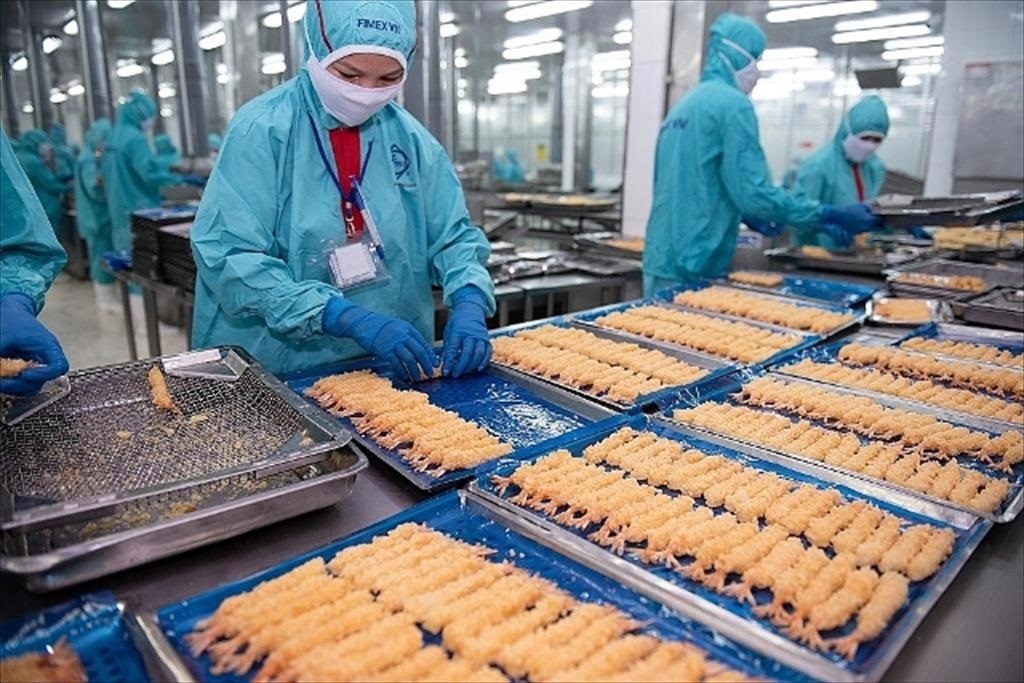
But Vietnam's competitiveness lies particularly in processing. Value-added products represent close to half of its export basket, and their importance is probably understated because peeled and other one-step processed shrimp remain classified within the same customs category as conventional frozen products. Vietnam faces stronger competition from Ecuador and India in raw frozen shrimp but remains competitive in breaded, marinated and other higher-value formats.
Vietnam also imports substantial quantities of shrimp for processing and re-export. In 2025, imports of headless shell-on shrimp reached around 90,000 tonnes, with India by far the largest supplier and volumes from Ecuador increasing. Van der Pijl estimated Vietnam's own vannamei production at approximately 330,000–410,000 tonnes after accounting for both exports and domestic consumption.
Van Vu Vu, PhD, Co-Founder and CEO of TOMOTA, believes even that calculation may underestimate domestic demand. “The export data doesn't really reflect the production in Vietnam,” Vu said, estimating that domestic consumption could exceed 200,000 tonnes. “The domestic market is even bigger than we could imagine.”
That domestic demand provides an important buffer for Vietnam's predominantly small-scale farmers, who face high input and diseasemanagement costs and have less purchasing power than larger producers. “We struggle a lot. The cost in Vietnam is really high, but luckily the domestic market is there, very strong, and it has the power to keep going through this challenge,” Vu said.
Indonesia: Farmers move into “safe mode”
Indonesia faces perhaps the most dilcult situation of the four. After exports increased slightly from 209,066 MT in 2023 to 214,021 MT in 2024, they fell to 201,113 MT in 2025. The annual decline masks a sharp change during the year: exports grew 14% year-on-year in Q1 and 17% in Q2 before contracting in the second half. The deterioration became particularly pronounced following the radioactive contamination incident and subsequent US FDA action, with exports falling 54% year-on-year in October. Weakness continued into 2026, with first-half exports down 14% year-on-year, and total exports could finish around or below 200,000 tonnes.
Indonesia's dependence on the US, which van der Pijl estimated at around 65-70% of exports, magnified the disruption. Shipments were temporarily redirected toward the EU and China, but that diversification slowed as US trade began normalizing.
For farmers, however, the most serious consequence of the radioactive contamination incident was not simply lower prices. Liris Maduningtyas, CEO of JALA and herself a shrimp farmer, explained: “From the farmers' perspective, and I'm also a farmer myself, it is not about the price that went down. Actually, it is not being able to sell. We can handle price down… But when nobody buys, this means we don't know what to do.”
The incident compounded a deeper profitability problem. Maduningtyas said Indonesian farmers had already responded to dificult economics by reducing production intensity. “In order to survive, we reduced the carrying capacity of the farms. I've seen a lot of farmers in Indonesia now operating more in "safe mode" she said.
That also changes what a recovery in Indonesian production might look like. Rather than simply pushing stocking densities higher, Maduningtyas sees potential to restore output by rehabilitating farms that have ceased operating. “The game now is not increasing the carrying capacity. The game is to fix the farm.”
Aris Utama, Director – Head of Sales & Marketing at Bumi Menara Internusa, also pointed to government-backed efforts to rebuild production. He highlighted two farming developments targeting around 4,000 and 52,800 tonnes of annual output, respectively, which he believes could help lift Indonesian exports back above 200,000 tonnes.
Different routes to resilience
The four countries therefore enter the next phase of the shrimp cycle from very different positions.
Ecuador continues to expand production while becoming more flexible in markets and product forms. India is relying on processing capability, market and species diversification to navigate trade uncertainty. Vietnam combines an established value-added processing sector with a domestic market that provides an important outlet for local farmers. Indonesia, meanwhile, is focused on restoring farm profitability and bringing production capacity back into operation.
Taken together, the four markets suggest that production volume alone provides an increasingly incomplete measure of competitiveness. Market access, processing capacity, product format, farm economics and the ability to adapt to shocks are also shaping which origins can continue to grow.
Source: Aquafeed.com
Other news
- Early stocking to get good price 21/12/2024
- Shrimp prices rise again in Vietnam, and reach 12-month high in India 28/08/2024
- Vietnamese Shrimp Industry Faces Many Challenges: Farmers Prefer Quality but Cheap Shrimp Seeds 01/08/2024
- Raw shrimp prices fall: Another challenge the shrimp industry must overcome 03/07/2024
- Storms in the shrimp industry may last in 2024 07/05/2024
- Vietnam's Seafood Exports Reach $2 Billion In Q1 03/04/2024
- King of shrimp industry profits in 2023 02/04/2024
- A difficult story for shrimp 11/03/2024
- Shrimp exports face a difficult problem 23/02/2023
- Vietnam’s shrimp exports reached 141 million USD in the first month of 2023 22/02/2023



SEABINA CO.,LTD
- Phone: +(84)0908 558 093
- Fax: +(84)0908 558 093
- Email: giau@seabinagroup.com
Certification

- GPKD : 0314499894, cấp ngày : 07/07/2017 bởi Sở Kế Hoạch và Đầu Tư TP. Hồ Chí Minh.
- Người đại diện: Nguyễn Khánh Giàu


